As the founder of the Gemstone Therapy Institute, I sometimes wonder why I didn’t look more closely at the scientific research on crystal healing sooner. When I finally did, what I found surprised me.
In search after search, I encountered essentially the same message: there is no scientific evidence that crystal healing works, and any apparent benefits can be attributed to the placebo effect.
So I decided to look closely at the research behind those claims.
I expected to find a substantial body of controlled research behind conclusions that this is definitive. I didn’t. The experimental literature was far more limited—and far more interesting—than the conclusions I had encountered online suggested.
So I Went Looking for the Evidence
Controlled experimental research directly testing healing crystals appears to be remarkably scarce.
The experimental literature I could find consisted of two experiments conducted over twenty-five years ago by psychologist Chris French and colleagues. Neither was published as a full peer-reviewed research article. The first was presented at the Sixth European Congress of Psychology in 1999; the follow-up was presented at the British Psychological Society’s 2001 annual conference and reported in a published abstract. [1, 2]
Then, in 2025, Escolà-Gascón and colleagues published a randomized placebo-controlled trial in CNS Spectrums examining whether Rose Quartz reduced measured anxiety more than a visually similar glass placebo. [3]
Taken together, that amounts to two conference experiments around the turn of the century, followed more than two decades later by a single full peer-reviewed randomized trial.
Given how confidently the reported benefits of crystal healing are often attributed to placebo, I found the scarcity of controlled experimental research remarkable.
That does not make these studies invalid, nor does it mean their findings should be dismissed.
The question, then, is how these specific findings came to be associated with much broader conclusions about healing crystals as a whole.
Chris French and Colleagues’ Crystal Experiments
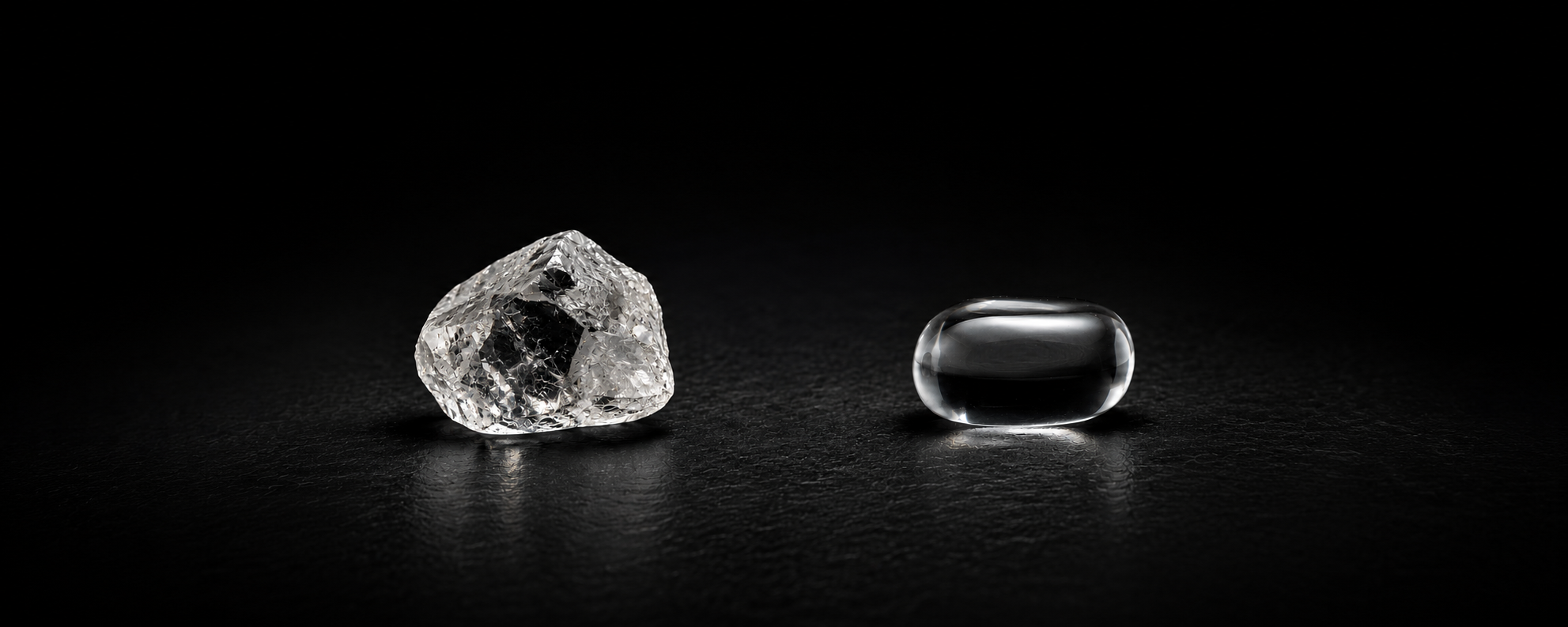
In 1999, psychologist Chris French and a colleague conducted an experiment in which eighty volunteers held either a genuine quartz crystal or an imitation crystal made of glass and reported what they experienced. [1, 4]
Half of the participants were primed beforehand with suggestions about what they might feel while holding the crystal. Those participants subsequently reported stronger sensations than participants who had not received the suggestions. Participants with stronger pre-existing paranormal beliefs also tended to report stronger sensations. [1, 4]
Whether participants held genuine quartz or glass made no difference in what they reported. [1, 4]
A follow-up experiment in 2001 used an improved double-blind methodology and again found no difference in reported sensations between genuine quartz and glass. The association with paranormal belief was also replicated, and reported sensations were associated with hypnotic susceptibility. The priming effect found in the first experiment, however, was not replicated. [2, 4]
These are meaningful findings.
Both experiments tested a familiar form of crystal use: people held a crystal and paid attention to the sensations they experienced. [1, 2, 4]
How Two Experiments Came to Carry So Much Weight
French himself has described how unusually influential these experiments became. Writing more than twenty years later, he noted that journalists continued to contact him about the research because they could find no other empirical work testing crystal power. [4]
He also expressed regret that the studies had never been written up for full publication. [4]
The scarcity of other experimental research helps explain why these two experiments came to carry so much weight in the public discussion of crystal healing.
Because the experiments were never reported in full research articles, the methodological detail available for independently evaluating them—including their precise materials, procedures, statistical analyses, and limitations—is limited. [4]
But nothing about that invalidates the central finding available to us: under the conditions tested, participants could not distinguish the subjective experience of holding genuine quartz from holding glass. [1, 2, 4]
The important question for this article is how much more we can conclude from that finding.
The Rose Quartz Anxiety Trial
The first full peer-reviewed randomized trial I was able to identify came more than two decades later.
In 2025, a study published in CNS Spectrums tracked 138 adults over 14 days using either genuine Rose Quartz or a visually similar glass decorative stone. Anxiety reductions occurred exclusively among individuals who reported a baseline belief in crystal efficacy. [3]
The statistical analyses found no evidence that genuine Rose Quartz reduced measured anxiety more than the glass placebo. [3]
Again, that is a meaningful finding.
The researchers had gone beyond asking participants what they felt while holding a crystal. They tested a specific therapeutic claim—whether their Rose Quartz intervention would reduce measured anxiety more than glass.
It did not.
Understanding the scope of that finding requires knowing what was tested.
Participants were instructed to soak the stone in salt water overnight. During the day, they were told to keep it close to them—for example, in a wallet or another item that remained with them. They could leave the stone inside its envelope or wrap it in a handkerchief. The intervention continued for 14 days. [3]
The study therefore tested one gemstone, Rose Quartz, using one particular protocol, for one measured outcome: anxiety. [3]
There is also an important qualification regarding the population. Participants were not recruited on the basis of having a diagnosed anxiety disorder. The authors themselves acknowledged that a clinical sample would have been preferable. [3]
Within this nonclinical population, the Rose Quartz intervention tested did not reduce measured anxiety more than glass. [3]
That is what the experiment established.
The Authors’ Conclusion
The authors presented six conclusions, interpreting their findings within a framework of placebo effects, belief, classical conditioning, and causal illusions. [3]
Their first conclusion is particularly interesting:
“In the contrasts made, no significant effects were observed that could support the supposed ‘efficacy’ of healing crystals in the anxiety level reductions over the placebo effect.” [Bold is mine.] [3]
The authors appropriately qualify their conclusion with “in the contrasts made.”
But notice the difference in scope within the sentence itself. The experiment tested a particular Rose Quartz intervention for anxiety, while the conclusion refers more broadly to the “efficacy of healing crystals.”
This may seem like a small distinction. But it becomes increasingly important as findings are summarized, cited, and repeated.
From Specific Findings to Broader Conclusions
Consider how the message changes as we move farther away from the experiments themselves.
The French experiments: Participants could not distinguish the subjective experience of holding genuine quartz from holding glass. [1, 2, 4]
French’s broader interpretation: In a later interview with Live Science, French stated, “There is no evidence that crystal healing works over and above a placebo effect.” [5]
Wikipedia: As of August 2026, under its heading “Scientific evaluation,” it states, “There is no peer-reviewed scientific evidence that crystal healing has any effect.” The same paragraph goes on to state, “Alleged successes of crystal healing can be attributed to the placebo effect.” The section then presents the French experiments as part of its scientific evaluation of crystal healing. [6]
Google: In August 2026, when I searched “scientific research on crystals,” Google AI summarized the evidence more broadly still: “Scientific consensus attributes reported wellness benefits to psychological focus, mindfulness anchors, and the placebo effect.”
Notice what changes along the way.
The original experimental findings are quite specific. Participants could not distinguish the subjective experience of holding genuine quartz from holding glass. A particular Rose Quartz intervention did not reduce measured anxiety more than glass in a nonclinical population.
Yet as we move from the experimental findings into the broader discussion, the language becomes much more encompassing. In the Google AI summary I encountered, the placebo explanation appeared not merely as an interpretation of a very limited experimental literature, but as “scientific consensus” about healing crystals generally.
What Has Science Actually Established?
There is an important distinction that can easily disappear as scientific findings enter ordinary conversation.
“There is no scientific evidence that crystal healing works” is not equivalent to “scientific studies have shown that crystal healing does not work.”
The first says that effectiveness has not been scientifically demonstrated. The second suggests that research has tested crystal healing broadly enough to establish that it is ineffective.
The experimental evidence does not establish whether crystal healing as a whole works or doesn’t work.
The French experiments found that participants could not distinguish the subjective experience of holding genuine quartz from holding glass. [1, 2, 4] The 2025 study found that the particular Rose Quartz intervention tested did not reduce measured anxiety more than a glass placebo in a nonclinical population. [3]
These are meaningful findings, and they should be taken seriously. But they are findings about the particular interventions that were actually tested.
The same distinction matters when placebo enters the discussion. Saying that Rose Quartz did not outperform a glass lookalike is not the same as saying that all reported benefits of crystal healing can be attributed to placebo. The latter is a much broader conclusion than the experiment itself established.
This is how a relatively small shift in language can create a very different impression.
A reader who encounters statements such as “crystal healing has been scientifically disproved” or “its effects are placebo” may reasonably assume that a substantial body of research has tested healing crystals across a range of applications and reached those conclusions.
The controlled experimental record is far more limited.
The experiments found no significant difference between the particular crystal interventions tested and their glass controls under the conditions studied.
They do not demonstrate that every form of crystal healing has been experimentally tested and found ineffective.
Nor do these specific findings establish that all benefits people report from healing crystals can be attributed to placebo.
How Scientific Messages Can Change as They Spread
This kind of change does not require anyone to deliberately misrepresent the research.
A study produces a specific finding. That finding is interpreted. The interpretation is summarized in another source. That summary is repeated elsewhere. Each step may seem reasonable on its own.
But over time, the qualifications surrounding the original finding can disappear.
In this case, the experimental findings are quite specific. But the broader statements that now surround them can leave a general reader with a very different impression: that science has tested healing crystals and shown that they don’t work.
This includes our final decision to remove “original.”
That goes considerably further than the experimental findings themselves and can create a sense of scientific certainty that the underlying evidence does not support.
So What Can We Conclude?
Crystal healing has attracted extraordinary and enduring public interest. Yet the controlled experimental research directly examining it remains limited.
The studies that do exist have produced meaningful findings about the particular interventions they tested. Those findings deserve to be taken seriously.
So what can we reasonably conclude from the evidence that does exist?
The experimental evidence does not support the conclusion that crystal healing as a whole has been disproved.
And of course, it doesn’t demonstrate that crystal healing works, either.
What it shows is that a small number of specific crystal interventions have failed to outperform glass controls under the conditions tested.
That is worth knowing.
The controlled experimental literature appears to be quite limited. Yet the conclusions many of us encounter when we ask what science has to say about healing crystals are considerably broader.
The evidence leaves important questions unanswered. Answering them will require more research.
Subscribe to Our Newsletter
References
1. French, C. C., & Williams, L. (1999). Crystal clear: Paranormal powers, placebo, or priming? Paper presented at the Sixth European Congress of Psychology, Rome, Italy, July 4–9, 1999.
2. French, C. C., O’Donnell, H., & Williams, L. (2001). Hypnotic susceptibility, paranormal belief and reports of ‘crystal power’. Proceedings of the British Psychological Society, 9(2), 186. Presented at the British Psychological Society Centenary Annual Conference, Glasgow, Scotland, March 28–31, 2001.
3. Escolà-Gascón, Á., Dagnall, N., Drinkwater, K., Denovan, A., & Benito-León, J. (2025). Placebo effects in alternative medical treatments for anxiety: false hope or healing potential? CNS Spectrums, 30(1), e70, 1–15. DOI: 10.1017/S1092852925100515.
4. French, C. (2021, April 21). Romance in the stones? The power of crystals vs the power of suggestion. The Skeptic.
5. Gordon, J., & Peterson, E. (2022, January 25). Crystal healing: Stone-cold facts about gemstone treatments. Live Science. Contributions by Rachel Ross.
6. Wikipedia contributors. (2026). Crystal healing. Wikipedia, The Free Encyclopedia. “Scientific evaluation” section. Accessed August 2026.
Search Record
Google AI Overview. Search query: “scientific research on crystals.” August 2026. Screenshot retained by author.
Isabelle Morton, B.S., is the founder of the Gemstone Therapy Institute and GEMFormulas, and the original visionary behind Diamond and Gemstone Therapy, which she began developing in 1987. She continues to study and explore the therapeutic properties and applications of gemstones and Diamonds. Isabelle continues to expand her library of educational material. Thousands of people and pets around the world have benefited from her work. Her dream is to see Diamond and Gemstone Therapy recognized as meaningful energy medicine modalities.
Learn more at gemformulas.com